
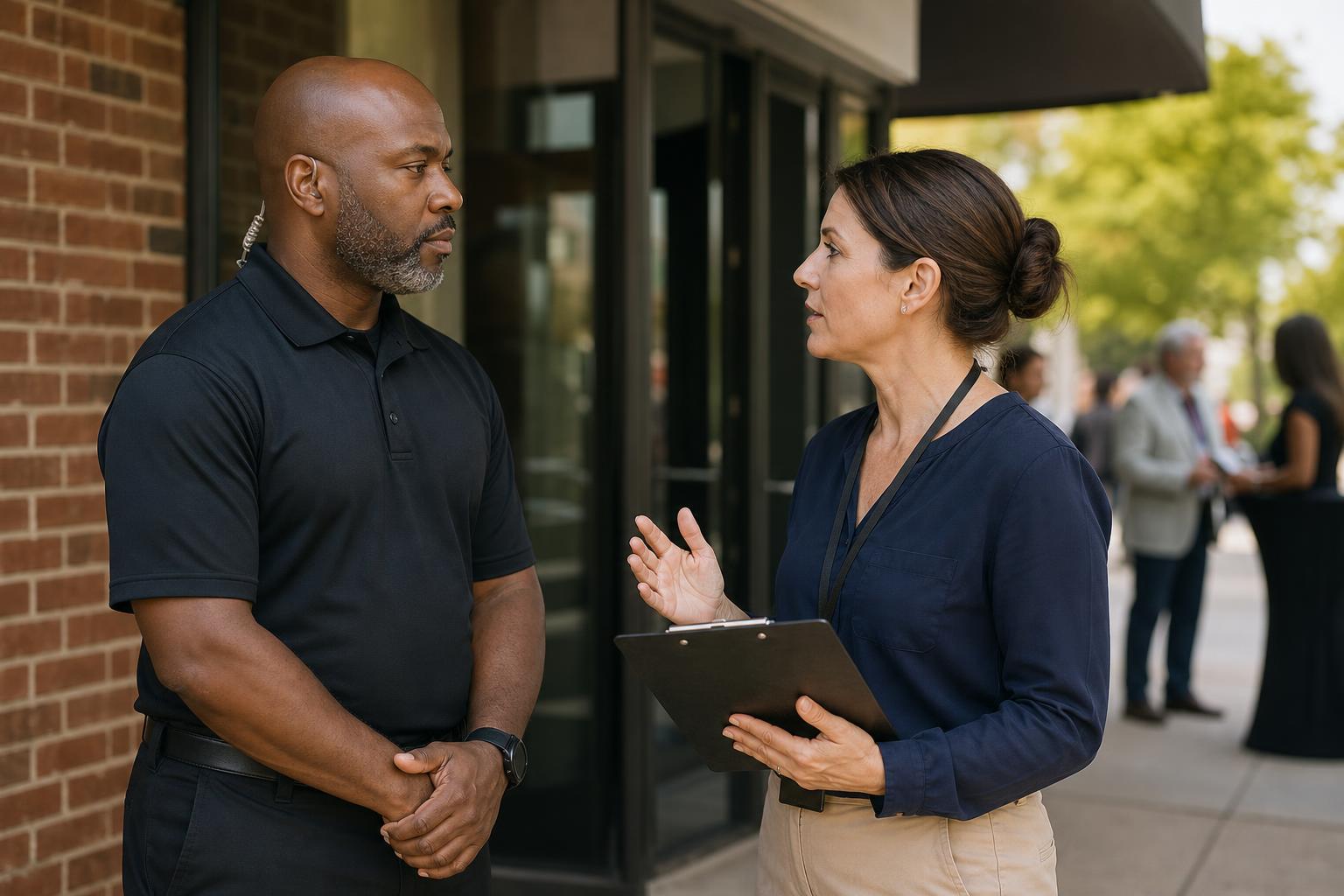
Before signing an agreement, a Maryland organizer should document the event profile, venue conditions, staffing expectations, service boundaries, emergency contacts, agency coordination, and change process. Good event security coordination turns a vague request for “guards” into a clear written scope everyone can review.
This matters because most event problems start as coordination problems. A door is covered, but the parking lot isn’t. A venue contact expects one thing. The organizer expects another. A written sheet helps prevent confusion.
Use this guide as a planning tool for events in Baltimore, Annapolis, Frederick, and nearby Maryland communities. It’s general educational information, not legal advice for a specific permit, contract, or site.
Table of Contents
Start with the event profile
The first part of event security coordination is simple: describe the event in plain language. Don’t start with how many people you think you need. Start with what is happening, where it is happening, and who will make decisions.
Your event profile should include the date, scheduled hours, setup time, breakdown time, and full venue address. Add the expected attendance, age range, ticketing method, performer or speaker schedule, and whether alcohol will be served.
Also note the physical layout. Is the event indoors, outdoors, or both? Are there public sidewalks, parking lots, loading docks, VIP areas, vendor areas, or backstage rooms? Include gates, doors, elevators, stairwells, and any areas that should stay closed to guests.
Then name the decision-makers. A private-security provider needs to know who can approve a schedule extension, change a post, pause entry, call venue management, or request an incident report. If three people give different directions, staff can lose time sorting it out.
For a small example, a nonprofit reception in Annapolis may only need guest assistance at one entrance and light parking observation. A large outdoor concert may need more detailed access monitoring, vendor coordination, and a weather plan. The right scope depends on the event, not a standard package.
Map responsibilities before requesting a quote
A quote is only useful when both sides understand the job. Event security coordination should separate security duties from venue operations, traffic control, medical response, fire safety, and law-enforcement responsibilities.
Ask what the assignment is expected to cover. Common event-security tasks may include observing entrances, monitoring access lists, checking restricted areas, assisting guests with directions, watching parking areas, or reporting suspicious conditions. The exact work should be written down.
Also write down what the private-security team is not doing. For example, venue staff may handle ticket scanning. A licensed alcohol vendor may manage service rules. Medical staff may handle patient care. Public agencies may handle road closures, emergency response, or other public-safety functions.
This boundary protects the event and the provider. It also helps the organizer avoid paying for the wrong coverage. If the concern is an unstaffed loading dock, an extra person at the front door may not solve that problem.
Police Protection Services LLC states that it serves businesses, organizations, properties, and communities across Greater Baltimore, Annapolis, and Frederick. Its security services page lists armed security, K-9 detection, area patrol, executive protection, and armed/unarmed coverage among its services.
Ask about armed and unarmed coverage
Event security coordination should include a careful discussion about armed and unarmed coverage. Police Protection Services LLC says it provides armed and unarmed coverage, and its services page explains that coverage is matched to the environment. That does not mean every event needs the same approach.
Armed coverage is not automatically the better choice. Unarmed coverage is not automatically enough. The decision should reflect the venue, the guest profile, the event history, access points, valuables, alcohol service, and any known concerns. The provider can help evaluate the assignment, but the final written scope should be specific.
Before signing, ask the provider to confirm the role, post locations, hours, supervision, escalation procedures, and reporting expectations. “Escalation” simply means what staff do when a concern becomes more serious. That could include notifying the event manager, contacting venue leadership, calling emergency services, or documenting an incident.
Do not leave this to assumptions. A phrase like “provide security for the event” is too broad. A stronger scope says who is assigned, where they are posted, what they monitor, who they report to, and what happens if attendance, weather, or timing changes.
Confirm the personnel description
Provider experience matters, but descriptions need context. Police Protection Services LLC describes assignments involving armed and unarmed officers, off-duty and retired police officers, K-9 handlers, loss-prevention personnel, and mobile patrol guards on its about page. Its homepage also describes armed personnel as off-duty, retired, or former police officers and identifies K-9-trained personnel on staff.
Those are company personnel descriptions. They should not be read as a promise that every assigned person has the same background. They also should not be confused with on-duty public police authority. Private security staff are not acting as a government agency unless a separate public authority says so.
For clear event security coordination, ask assignment-specific questions. Who is expected to work this event? What role will each person fill? Who supervises the team? What qualifications or experience fit this venue? How are replacements handled if someone becomes unavailable?
If K-9 detection, executive protection, mobile patrols, or loss-prevention support may be relevant, ask whether those services fit your event. Do not assume they are included. Specialized services should be named in the written agreement if they are part of the job.
Use a venue-and-event planning framework
A planning framework helps you ask better questions. The official CISA Mass Gathering Security Planning Tool describes a framework that considers venue characteristics, event-planning checklists, and security and emergency-plan considerations.
Treat that tool as a starting framework, not a substitute for a site-specific professional assessment. It does not guarantee safety. It also does not replace local permit rules, venue requirements, insurance review, or agency direction.
For event security coordination, turn the framework into practical questions. What are the venue’s main access points? Where could crowding occur? What areas are restricted? How will staff communicate? Who calls emergency services? Where should responders enter if needed?
These questions help the provider understand the event environment. They also help the venue, vendors, and organizer use the same map. A simple floor plan with posts marked can be more useful than a long email thread.
Coordinate with the venue and public agencies
Maryland event requirements can vary by city, county, property type, and event activity. An event in Baltimore may involve different contacts than an event in Frederick or Annapolis. Always identify the applicable municipality or county early.
Confirm who handles fire and life-safety requirements. “Life safety” means steps that protect people during emergencies, such as keeping exits clear and maintaining emergency access. Ask the venue who manages occupancy limits, alarms, evacuation routes, and fire-lane access.
Also confirm who contacts local police, fire, or emergency medical services when needed. A private-security provider can support the event plan within its agreed role. It should not be described as directing public agencies, replacing emergency responders, or guaranteeing a response outcome.
If the event affects sidewalks, streets, public parking, deliveries, or neighborhood access, ask the venue or local authority what approvals may be required. Do not assume a security provider can obtain permits or approve public-space use unless that duty is specifically confirmed and lawful.
Put boundaries in the agreement
The written agreement should reflect the coordination sheet. If the sheet says one thing and the contract says another, the contract may control. Ask a qualified professional to review legal terms when the event is large, complex, or high risk.
At a minimum, document the service area, start and end times, number and type of personnel, supervision, breaks, uniforms, and equipment expectations. Include how staff will check in, where they will be posted, and who can approve changes.
Incident reporting should also be clear. Ask what gets reported, when the organizer receives the report, and who receives it. A report may document observations, actions taken, contacts made, and the time of an event. It is not a guarantee that a problem will be prevented.
Event security coordination should also address schedule extensions, weather changes, attendance changes, and venue changes. If a reception runs two hours late, can coverage extend? Who approves the extra time? How is that billed? If a storm moves guests indoors, which posts change?
Compare providers using the same questions
Comparing providers is easier when each one answers the same questions. Ask for a written scope instead of only a price. A low quote may leave out posts, supervision, reporting, specialized personnel, or schedule flexibility.
Request confirmation of licensing, insurance, references, personnel qualifications, and replacement procedures. Do not rely on a general statement if you need assignment-specific information. Ask how the provider matches personnel to the environment and how the supervisor communicates with your event lead.
Police Protection Services LLC describes work ranging from a single overnight construction-site post to standing programs across multiple properties. That range shows why details matter. A one-night gala and a multi-site property program need different plans.
If you are also researching Baltimore-specific event staffing, the company’s article on Baltimore event security discusses off-duty and retired personnel in that context. Use it as background, then build your own event-specific coordination sheet.
7 questions to answer before signing
Use these seven questions as a short pre-contract check. They keep event security coordination focused on decisions that affect the day of the event.
- What exact areas will security cover, and what areas are excluded?
- Who has authority to change posts, hours, or instructions on event day?
- Will coverage be armed, unarmed, or a mix, and why does that fit the assignment?
- What personnel experience or qualifications are expected for this event?
- How will the security team communicate with the organizer, venue, and emergency contacts?
- What incidents must be reported, and when will written reports be provided?
- How will weather, attendance changes, delays, or added hours be handled?
Keep the answers in one shared document. Attach maps, schedules, vendor lists, emergency contacts, and venue rules. The goal is not to create paperwork for its own sake. The goal is to help every responsible person understand the same plan.
FAQs about event security coordination
How early should I contact a security provider?
Contact providers as soon as the date, venue, and basic event profile are known. More lead time helps with staffing, site review, and coordination with the venue.
Do I need armed coverage for my event?
Not always. Armed or unarmed coverage should be based on the assignment, setting, access concerns, and provider assessment. It should be confirmed in writing.
Can private security handle police duties?
Private security can perform agreed private-security duties. Do not assume private guards have on-duty police authority or can direct public agencies.
What should I send when asking for a quote?
Send the event profile, venue map, schedule, expected attendance, alcohol details, access points, restricted areas, and your questions about event security coordination.
Who should talk to the venue?
The organizer should name one lead contact. That person can coordinate the venue, provider, vendors, and public-agency contacts when appropriate.
Police Protection Services LLC is based in Pasadena, Maryland, and lists office hours of 8:00 a.m. to 5:00 p.m. For help discussing event security coordination in Baltimore, Annapolis, Frederick, or nearby communities, visit Police Protection Services LLC or call (410) 977-1510.


